Box Cricket vs Full Cricket: Which One Is Right for Your Squad?
Compact and fast, or full-sized and traditional, the actual differences that matter.
Both formats look like cricket. That's where the similarity ends. If you've been assuming box cricket is 'cricket, but in a box', you're going to have a confusing first game. Here's what actually changes, and how to pick.
Pitch and dimensions
- Full cricket: 90m x 60m minimum, real 22-yard pitch, boundary rope, deep-field positions.
- Box cricket: usually 60x30 or smaller, walled or netted on all four sides, no traditional boundary, walls count.
Format
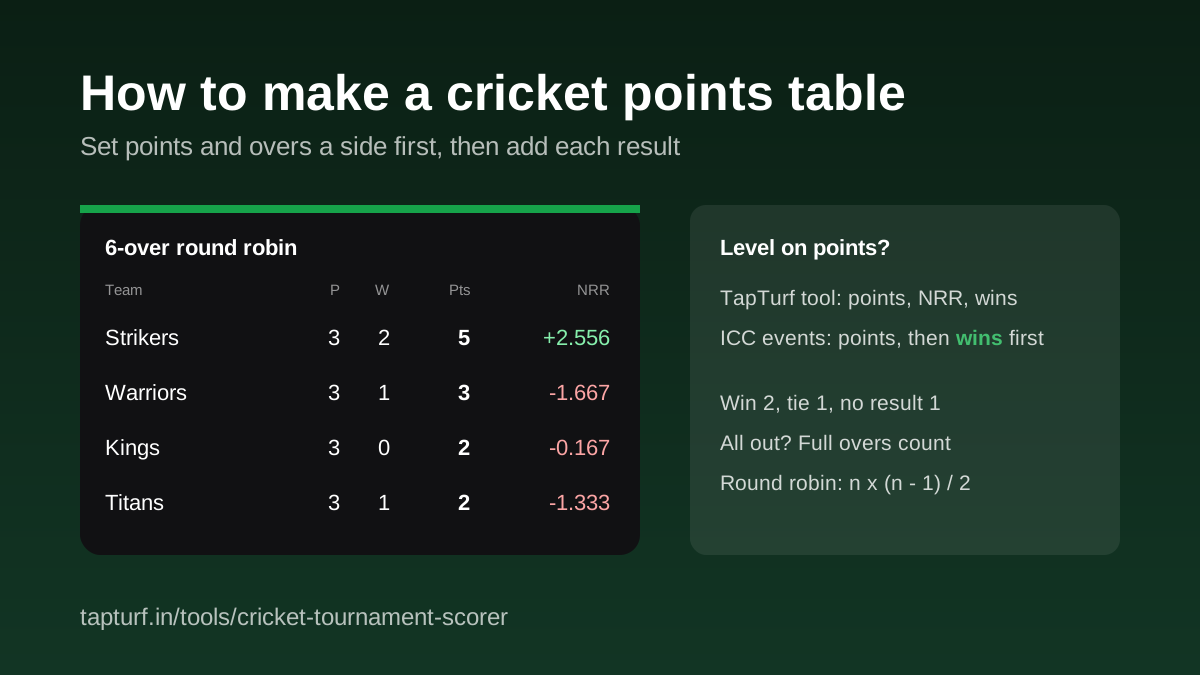
Full cricket at a turf usually plays as 6-a-side or 8-a-side, 6–10 overs a side, 90–120 minutes total. Box cricket runs 6-a-side, 5–6 overs a side, 60–75 minutes. The compressed format is why box cricket has taken over, it fits after work, and everyone actually bats and bowls.
Ball
Both formats mostly use a tennis ball with tape on it (the tape adds swing). Serious box cricket leagues sometimes use a heavy tennis ball for extra bounce. Leather ball on turf is possible but almost never done in casual bookings, insurance and injury reasons.
Rules that change
- One-tip-one-hand catch, box cricket often allows a bounce off the wall counted as a catch. Confirm before you start.
- Wall runs, a shot off the back wall is usually 1, side walls 2, straight boundary 4, straight over the roof 6. Every turf tweaks this.
- No LBW in box cricket, the pitch is too short and the umpiring is one guy on his phone.
- One over per bowler, keeps the format inclusive.
- Last-man-standing, when 5 are out, the last batter bats alone.
Cost
Box cricket is cheaper per person than full cricket. A 60x30 box for 90 minutes at ₹1,200 split 12 ways is ₹100 a head. Full cricket at ₹1,800 for 2 hours split 16 ways is ₹225 a head. The gap widens if you can't fill full-format numbers.
Which format fits which squad
- 6–8 regulars, want an after-work game: box cricket, every time.
- 12–16 regulars, weekend league: full cricket at a proper turf.
- Mixed skill levels, some beginners, some experienced: box cricket is more inclusive because everyone bats and bowls.
- Serious cricketers wanting genuine match practice: full cricket on real astroturf.
The vibe difference
Box cricket is faster, louder, funnier, walls bounce shots back in weird ways, everyone gets involved, catches are wild. Full cricket at a turf feels more like real cricket, proper spells, field placings, the deep field standing there for 6 balls doing nothing. Both are great; pick by mood.
See every box cricket and full-turf option near you.
Browse cricket turfsCommon rule agreements to make BEFORE the first ball
- How many overs and how many per bowler.
- What counts as out, wall catches yes/no, one-hand-one-bounce yes/no.
- How wall bounces are scored (side vs back vs roof).
- Powerplay overs, first 2 usually mandatory 4 fielders in the circle.
- What happens to the last batter, bats alone, or last-wicket-with-runner.
One habit that saves every game
Write the score. Not 'someone tracks it in their head', actually write it on a phone note or scoresheet. Both formats end in ugly disagreements at least once a season because nobody wrote the score down. 30 seconds of admin, hours of peace.
Like this post? Tell Google you want to see more from TapTurf.
 Add TapTurf as a preferred source on Google (opens in a new tab)