What Is the DLS Method in Cricket?
Rain stops play and the chase changes. Here is what the DLS target on TV is actually using.
The DLS method resets the target in a limited-overs match when rain or another stoppage cuts the game short. DLS stands for Duckworth-Lewis-Stern. The DLS target on the TV graphic is the score the chasing side needs to win, worked out from the overs and wickets each side had left, not from the overs alone.
Frank Duckworth and Tony Lewis built the original method. It was first used in international cricket in early 1997. In November 2014 it was revised under Professor Steven Stern and took his name. His 2016 paper describes that revision as a way to handle the very high scoring rates now common in limited-overs cricket, especially in T20. ICC playing conditions call this the Stern edition, and say the revised target is computed with the ICC Duckworth-Lewis-Stern calculator.
The number on your screen is that calculator's output. This page explains the idea in a few minutes. It does not include the official resource table, and it will not give you a target for a real match.
What does the DLS target mean?
In a full match the chasing side must score one more run than the side that batted first. When overs are lost, that simple total is no longer a fair comparison, because the two sides did not have the same chance to score. The DLS target is the revised score the chasing side needs in the match that is actually left.
Ten overs with all ten wickets is a different chance from ten overs with two wickets left, because a side that still has wickets can attack. A full 50-over innings starts at 100% of the resources. That is the scale in the ICC note. A match that was always shorter, such as a T20, starts below 100% on that same scale. The exact percentages used on TV are not printed here.
Drag either slider. More overs left, or more wickets in hand, means more resources.
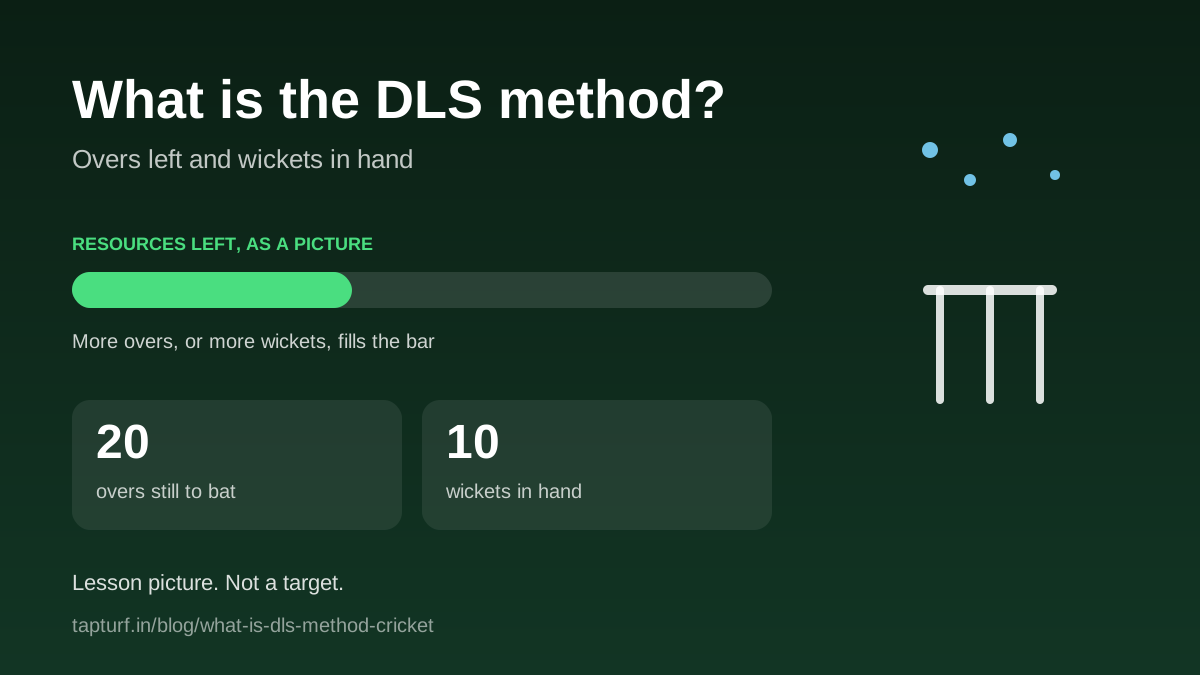
More overs still to bat, or more wickets in hand, fills the bar. Fewer of either empties it.
0 to 50 on this lesson picture only. The paragraph above says a T20 starts below 100% on the 50-over ICC scale, and the exact percentages are not printed on this page.
0 to 10. Ten means no wicket lost. Zero means all out, so the bar is empty.
50-over lesson picture
20 overs still to bat and 10 wickets in hand. On this 50-over lesson picture, the lesson bar is partly filled. This is not how a T20 is scored on the official scale.
Lesson only. This bar is a 50-over lesson picture. It is not the DLS table, not an official resource percentage, not how a T20 is scored on the official scale, and it does not give a target.
How is the revised target worked out?
The usual picture on TV is a chase that has lost overs, so the chasing side has fewer resources than the side that batted first. For that case, the shape of the sum is:
That is the teaching version of the sum in the ICC's written note, for the older Standard Edition, when R2 is less than R1. The Stern edition on television is done by the calculator, including a stoppage in the middle of an innings. Read the sum so the graphic makes sense. It is not a way to set a real target.
A worked example with made-up numbers
Suppose Team 1 scored 180 in a full 50-over innings. A full 50-over innings starts at 100%, so R1 is 100. Pretend the stoppage leaves the chase with 73% of a full 50-over innings, so R2 is 73. The 73 is invented for this lesson. It is not a DLS figure, and it is not from any official table.
180 × (73 ÷ 100) = 131.4. Ignore the decimal and you have 131. Add 1. The teaching target is 132. One run short of that, 131, would be the tie score in this lesson.
| Step | Figure |
|---|---|
| Team 1 score | 180 |
| R1, a full 50-over innings | 100% |
| R2, invented for this lesson | 73% |
| 180 × 73/100, decimal dropped | 131 |
| Teaching target, this lesson only | 132 |
If rain ends the match during the chase, the score is compared with a par score. In the ICC's written method, par is the same sum without the added run. In this lesson that is 131. More than par and the chasing side is ahead, level is a tie, and less than par means they are behind. The par on a broadcast comes from the calculator too.
Sometimes the target goes up. That happens when the first innings was cut short, so the chasing side has more resources than Team 1 had. The chasing side knew the length of the innings and could bat for that length. The calculator sets the higher target. This page stays with the common case: the chase has fewer resources, and the target comes down.
Why is cutting the target by overs wrong?
An overs-only cut is the old average run rate method. Lose 10 overs from a 50-over chase and take four-fifths of the score. The ICC note says the resources are not in that direct proportion. Overs later in an innings are not worth the same as overs at the start, and the wickets still in hand change what the remaining overs are worth.
Wickets matter more late. One wicket lost in the first over still leaves a long innings in which to rebuild. The same wicket with a few overs left takes away the chance to score quickly with wickets in hand, which is the part of the innings modern sides use hardest. Stern's revision was aimed at those high scoring rates, especially in T20. Keeping wickets late in a rain-affected chase changes the resources more than the same loss at the start.
Does turf or box cricket use DLS?
Usually, no. A turf or box-cricket game is a booked slot with an agreed number of overs. If rain stops it, the group shortens the match, moves the slot, or splits what is left of the booking. You do not reset a target with DLS. Some formal matches on a full ground do, when their playing conditions say so. A Sunday cage game almost never does.
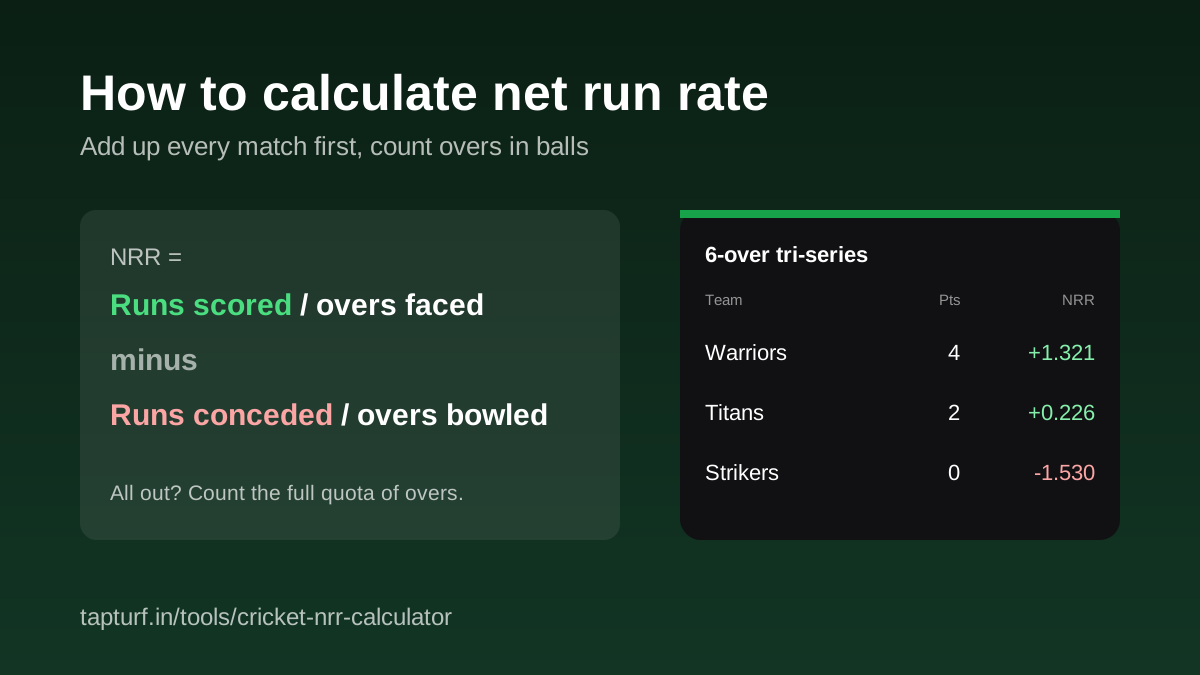
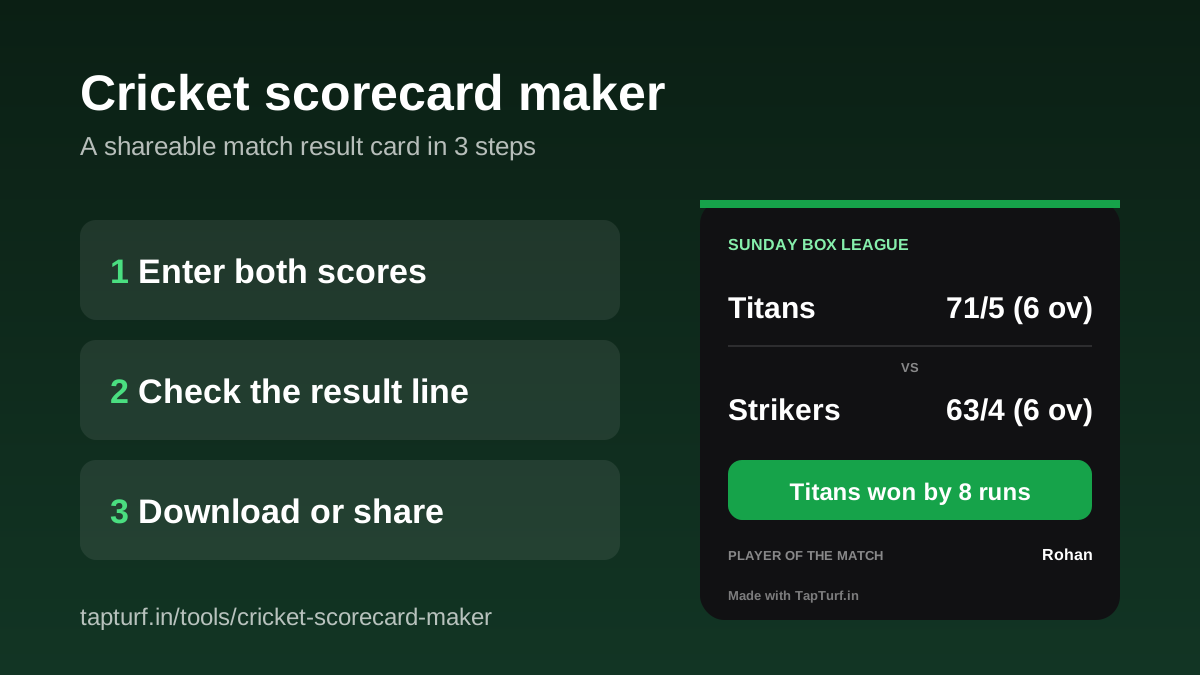
TapTurf's scorecard maker, tournament scorer and net run rate calculator do not apply DLS. They use the scores you type in. When two sides in a league finish level on points, those tools separate them with net run rate, which is a different sum from a DLS target.
Level on points after a turf league? Net run rate is the separator, not DLS.
Open the NRR calculatorAfter the match, turn the score into a card for the group.
Make a scorecardRunning a small league on a turf? Keep the table here. It does not do DLS.
Open the tournament scorerWhat does DLS stand for?
What is the DLS target on TV?
Why not just reduce the score in proportion to the overs lost?
Can a DLS target be higher than the first innings score?
Can I calculate a DLS target with this page?
Does box cricket or turf cricket use DLS?
Sources
- ICC, Duckworth Lewis Stern
- ICC playing conditions, Duckworth-Lewis methodology for re-calculating the target score in an interrupted match (Stern edition by calculator; written sum is the Standard Edition)
- Steven E. Stern, The Duckworth-Lewis-Stern method: extending the Duckworth-Lewis methodology to deal with modern scoring rates, Journal of the Operational Research Society, 2016
- Cricbuzz, Introducing Duckworth-Lewis-Stern method (2015 World Cup coverage)
The 73% in the example is made up for teaching. It is not an ICC resource percentage. No official DLS table is printed here. TapTurf's scorecard maker, tournament scorer and net run rate calculator were checked in the site code on 1 November 2026: none of them applies DLS.